
← Back to projects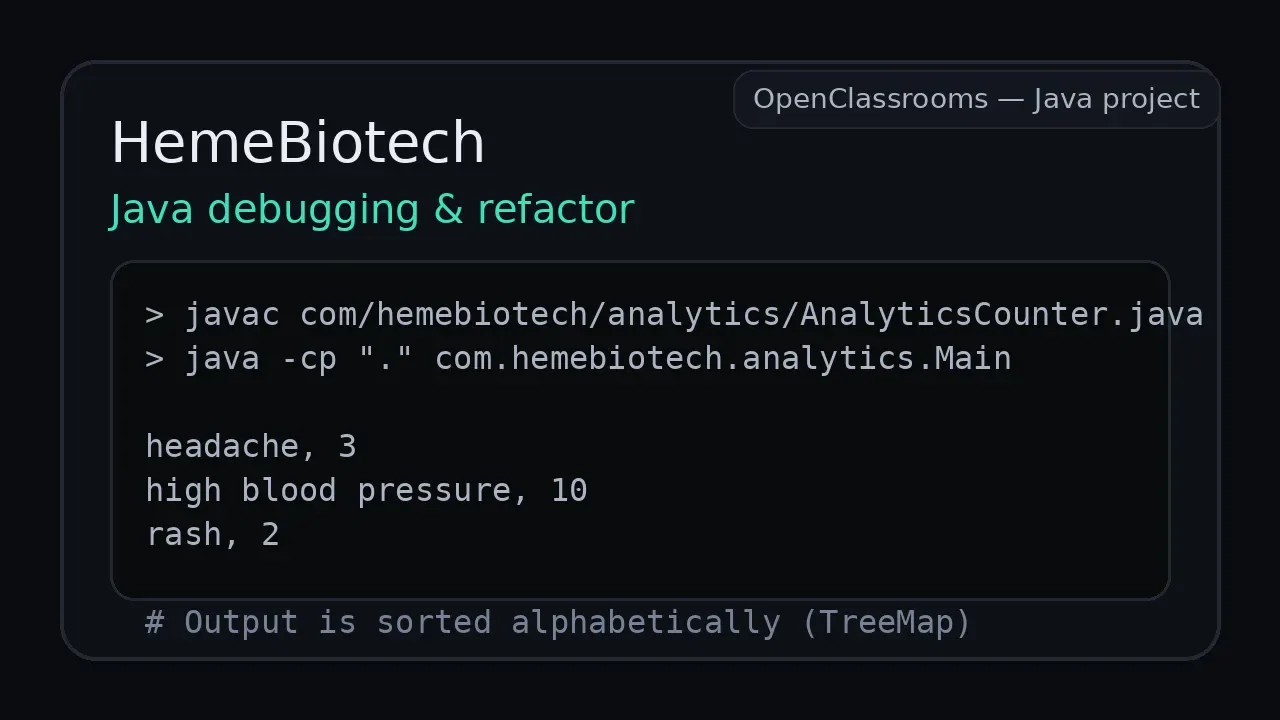
Case study
Java debugging & refactor (Heme Biotech)
Debugging and fixing a Java application for medical needs prediction at Hemebiotech.
Context
Heme Biotech ("Remedies for those we love"), a pharmaceutical company specializing in blood disorders, had assigned Alex, a chemistry researcher, to build a small Java trend-analysis tool: read a symptom file and output each symptom's count, alphabetically sorted. Alex got stuck with a counter that always returned 0. Caroline, CTO and co-founder, handed the rest to an incoming dev intern: diagnose the bug, refactor to Java OOP standards, and document everything in Javadoc for team handover.
Problem Scope
- Symptom counter consistently returning 0, regardless of the actual number of occurrences in the file (e.g. 3 occurrences of "headache" → 0 in the output)
- Monolithic code with no separation of concerns between reading, counting and writing
- No interfaces or OOP patterns in place
- Naming not compliant with Java camelCase conventions
- No Javadoc documentation available for team handover
Solution & Deliverables
- Bug fixed via TreeMap.merge() aggregation: a single data structure handles both exact counting and native alphabetical ordering — no separate sort step needed
- Reading delegated to ReadSymptomDataFromFile, implementing the ISymptomReader interface (getSymptoms())
- Writing encapsulated in WriteSymptomDataToFile, implementing ISymptomWriter
- AnalyticsCounter refocused on 2 responsibilities: countSymptoms() (TreeMap aggregation) and writeSymptoms() (output file generation)
- Entry point isolated into a dedicated Main class orchestrating read → count → write
- camelCase naming applied throughout the entire codebase
- Full Javadoc on all public methods
- result.out file generated with alphabetically sorted symptoms and exact counts
Stack & Technologies
- Java 8+ — primary language
- TreeMap — data structure for natural ordering and accurate counting
- Java Interfaces — ISymptomReader, ISymptomWriter
- Javadoc — automated code documentation
- Git — dev → main workflow, atomic commits per step
- IntelliJ IDEA — development environment
Project Timeline
- 1Analysis & diagnosisCode review, bug identification (TreeMap logic), mapping of OOP violations
- 2Bug fixReplaced broken counter logic with TreeMap for correct counting and natural ordering
- 3OOP refactorInterfaces created, classes separated, camelCase naming applied throughout
- 4DocumentationFull Javadoc written for all public methods
- 5Validation & deliveryManual testing, result.out generation, defense validated with 2/2 skills
Defense Results
2/2
Skills validated
1 critical
Bugs fixed
4
Classes created
2
Interfaces
Screenshots